

(This investment analysis is published exclusively at The Investment Editor’s Cut)
A Pair-Trade Idea Featuring the Stocks of Walmart Inc. (WMT) and Target Corp. (TGT)
I tend to be skeptical of companies/stocks that market participants, in large part, deem “bulletproof”. In my view, there’s always a cannonball out there that can bring down a fortress. Ignoring black swan potential though, in investment markets those so-called “bulletproof” companies usually command almost dizzying valuation multiples often despite low growth. A few example companies (of mine) would be Costco (54x TTM P/E), Apple (39x TTM P/E), and Cintas (46x TTM P/E). I’d even throw JPMorgan into this ‘bulletproof valuation’ group, as the bank is trading at a very rich 16x multiple for its sector. ¿Has everyone forgotten about the London Whale?
Right now I want to focus on Walmart (WMT) though: it’s ~2.5% earnings yield (1 ÷ P/E), ~$820 billion market cap, and ~4% expected growth. Even in best of times, shielded from inflation and tariff concerns, I’d be hard-pressed to accept such a low earnings yield (U.S. Treasuries pay ~4%) from a mature retail juggernaut. This is a company that, from my vantage point, has done almost everything right – and that’s a problem from an investment point of view.
Shareholder value is often unleashed from poorer companies becoming average companies, or average companies becoming great companies. Once a company is already great, operating like a hocheffizient German factory, there are no longer any low-hanging fruit. In fact, when I’m wearing my investor hat, I often see black marks like bad management teams favourably, like an opportunity for an improved situation, not a reason to look elsewhere.
On that note, these days the opportunity to pair-trade Walmart and Target looks hard to pass up. Let’s begin with a visual.
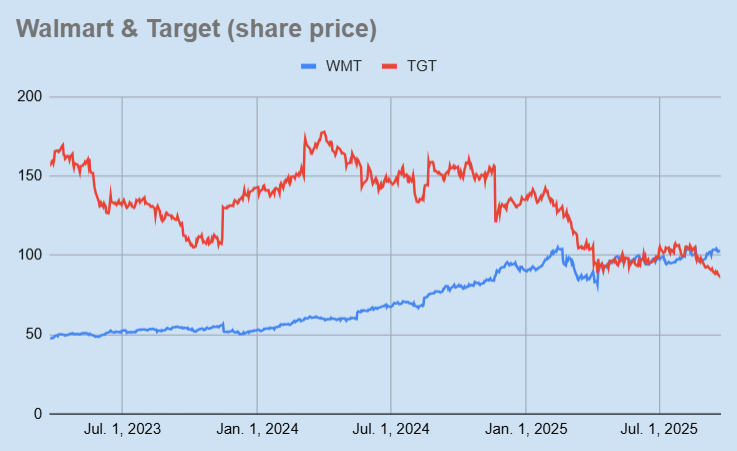
Little description is needed for the above. Walmart and Target have been heading in opposing directions for years, although things have really accelerated here in 2025. Two-and-a-half years ago, TGT was worth $156.22, and WMT just $47.27. Walmart stock is now trading about 20% higher that Target’s common share price.
Operating Results
Walmart has been operating like that well-oiled machine. Growth has been steady in the mid-single digits, and gross margins have held near 25%, despite higher growth in low-margin grocery items. Walmart has successfully threaded the needle of being a brick-and-mortar giant that is also relevant in e-commerce (e-commerce growth was recently +25%). The company has a supply chain that is the envy to almost everyone in the world (except if your name is Amazon). Faster delivery speeds have been pleasing to customers.
At Target meanwhile, growth has not only stalled, but revenues have seen small declines. E-commerce is rising at only a mid-single digit clip. Gross margins have actually improved, although that’s partially attributable to the fact that Target has all but lost the grocery war to it’s bigger peer. Further, unfortunately most of those GM gains have been eaten up by higher operating expenses. Target’s inventory turnover has slid back down to the ~8x level, while Walmart’s has rebounded back to 12x from a pandemic low of ~10x. That seems like an indictment of Target’s distribution fulfilment strategy.
Metrics Comparison
Indeed, these two companies are going in opposite directions. But to what degree should their relative valuation metrics truly diverge? Some key valuation metrics are listed below:
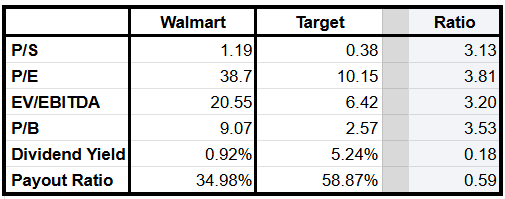
Especially in retail, marginal improvements can pack a big punch, and consumer habits don’t tend to change quickly. To the victors go the spoils, as they say, and Walmart will indeed reap the fruits of their dominance over rival Target. However, the difference between what an investor currently pays for a share of WMT and a share of TGT is just massive. As you can see above, Walmart is now more than 3x pricier than Target on P/S, P/E, P/B, and EV/EBITDA (Target Corp. also carries more leverage).
Potential Levelers
Looking at Walmart shares exclusively, I’m astounded at how the market is valuing this firm. As I mentioned in the intro, even in the sunniest days, I’d be hard-pressed to add shares of WMT to my portfolio at the current valuation. However, I’m actually one of those market participants who currently believes that behind those bright skies lies a dark and unpredictable storm. Let’s call these storm formations “Tariffs” and “Inflation”. Equity investors have bid WMT shares to a 40x P/E, as if the company will glide through the storm clouds completely unscathed, or that no storm will arrive in the first place. In my opinion, both of these mindsets are just wishful thinking.
Walmart’s supply chain runs much more efficiently and profitably than does Target’s, and in my view that makes Walmart even more vulnerable. This is a business that has been operating with very few kinks, but systemic disruptions will be hard to dodge, and may cause a more serious dislocation in Walmart’s business operations than expected. While there are both yaysayers and naysayers out there, I’ve heard credible reports that U.S. retailing has thus far been able to evade serious impact from tariffs due primarily to mass importing of goods prior to the enactment of said tariffs. Investors must not forget that some 70% of Walmart’s inventory comes from China, and that the effective U.S. tariff rate on Chinese goods reportedly hit ~39.8% in June. That’s up from just ~10% at the start of the year. It’s virtually impossible to dismiss the significance of the inevitable upcoming increase in product costs for Walmart and other U.S. retailers.
Over at Target, earlier this year it was reported that only about 30% of inventory was sourced from China. This, along with Target’s excess inventory situation right now, could prove quite beneficial in the months and quarters to come. Current Target CEO Brian Cornell is actually set to leave his post within the next 6 months. With his company’s stock at a 6-year low, Cornell might be walking out with his tail between his legs as he exits Target Plaza for the last time. However, he’s left incoming CEO Michael Fidelke with reduced China reliance, a stash of low-cost inventory, and extremely low investor expectations. Target obviously won’t walk away unscathed if higher import prices and a weakening consumer do emerge, but there’s a lot of pessimism already built into the shares at this juncture.
Long TGT, Short WMT
In my view, it’s high time for the relative performance for Target and Walmart to reverse. While hopeful optimism for a new incoming CEO at a struggling firm is reasonable, it will indeed be a difficult environment (if I’m correct about the incoming storm) for Target to climb out of the hole it currently finds itself in. At the end of the day though, Target isn’t going anywhere in the long term, and an ~10x-11x P/E seems like a very undemanding price to pay. Meanwhile, I am very bearish on shares of Walmart, which I believe will look like a much less bulletproof company than people commonly think, especially when hard times hit. Those extra few impulse/discretionary purchases at the store will likely be cut. At at ~39x multiple, shares of WMT just look bloated – a potential sign of too many investor dollars chasing companies that have been performing well.
Kicker: Even if the current gap between WMT and TGT shares remains, the long TGT/short WMT combo is set to net a 4%+ dividend yield spread annually.
NOTE: Engaging in any Shorting of securities opens an investor up to unlimited upside risk. Please consult with your financial advisor.

About the author:
Jeffrey Fischer is a CFA Charterholder and the founder of The Investment Editor’s Cut. He was previously an investment analyst principally at Seeking Alpha. He is a CFA Charterholder with a 25+ year career in capital markets.
Disclaimer:
Content featured on The Investment Editor’s Cut website or newsletter constitutes investment research and analysis, but does not constitute investment advice. Readers should consult with a professional financial advisor before taking any investment actions.
Leave a Reply