
Back in late-September of last year, The Investment Editor’s Cut (IEC) presented our one and only official pair trade idea**. Jeffrey Fischer, CFA, owner and operator of the IEC, paired left-for-dead Target Corp (TGT) with its mighty (seemingly) can-do-no-wrong peer Walmart (WMT).
Let’s first revisit the factors that powered the decision to invest in Target while simultaneously betting against** Walmart. We’ll then calculate how profitable the pair trade has been, before offering some concluding words of reflection.
The IEC Exclusive TGT/WMT Pair Trade Thesis
On September 24, 2025, I published an IEC Exclusive here on The Investment Editor’s Cut website titled, “Cue Up The Big Retail Pair Trade“, proposing that general merchandise retailer Target (TGT) was an absolute bargain compared to industry darling Walmart Inc (WMT).
-A $5.00 /month full access membership was required to view the original trade idea below.

-A $5.00 /month full access membership was required to view the original trade idea above.
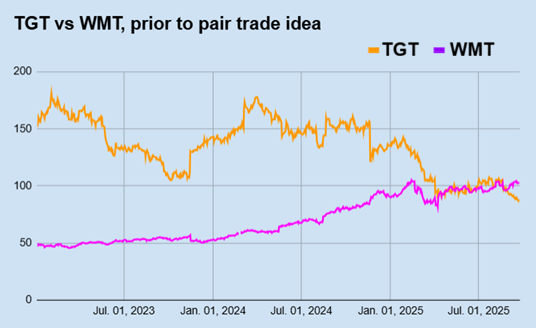
At the time of my report, TGT shares had fallen from above $150 in early 2023 to under $100. Meanwhile WMT stock had risen from ~$50 to more than $100 over the same time frame. The below chart makes evident just how opposing these trends were.
Contrarian investing has many appealing traits, but is also riddled with potential pitfalls. The concept of inertia is one of them. In addition to being a song from one of my favorite bands Massive Attack, inertia is the tendency for an object in motion to continue moving in the same manner until it’s confronted by another force. When an industry-leading firm is knocking the ball out of the park, as Walmart was, it can often do so for a sustained period of time. Walmart had been experiencing wonderful traction with their online sales, an improving inventory turnover, and dependable revenue growth in the ~5% range. Margins were also steady-to-higher, despite a greater focus/weight on grocery. In increasingly difficult times for many in the K-economy, Walmart was a clear winner in the discount grocery space and likely to pick up market share.
Meanwhile, a company/stock that is in a downward trend can also keep doing so for quite awhile. That statement is actually quite a propos for the current stock market environment here in Summer 2026, as many value stocks without direct/clear ties to the AI trade are simply garnering very little investor interest these days. (The IEC highlights many of them regularly in our handpicked Daily Features).
Back in September 2025, Target was facing declining sales, uninspiring digital growth, and inventory turnover had slumped. The company was about to undergo a CEO transition from Brian Cornell to Michael Fiddelke, who was the existing COO. The market held a dim view of Fiddelke’s selection for the top job, as investors had preferred that Target bring in an outsider who would be more likely shake up the status quo. Target’s share price was in the dumps, near a 6-year low, last September.
Qualitatively, there were plenty of reasons for investors to favour Walmart (WMT) stock for their portfolio, and shun Target (TGT)….and in fact very many investors were doing just that. My IEC Exclusive feature suggested THE OPPOSITE: Buy TGT, and Sell** WMT. I based the decision on two factors: i) the metrics, and ii) my view of potential catalysts.
Metrics
I presented the following WMT/TGT metrics comparison table here at the IEC, back in late-September:
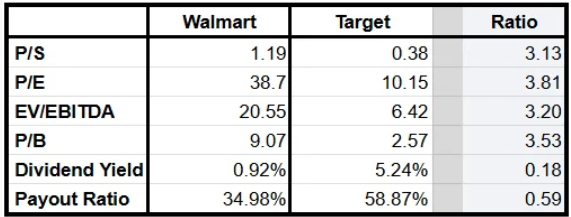
Walmart (WMT) stock absolutely deserved to trade at a premium to Target (TGT) stock (and still does), given its moat and momentum in key growth segments, against its peer’s stagnant growth, worsening operational metrics, and leadership uncertainty. However, the size of that premium looked very excessive. In key metrics such as Price/Sales, Price/Earnings, EV/EBITDA, and Price/Book, WMT shares were trading at 3x or more the relative level of TGT! Meanwhile WMT stock yielded a dividend of less than 1%, as compared to a more than 5% yield for Target. I offered a view that even if the valuation gap didn’t narrow, that owning Target against Walmart would yield a handsome dividend spread.
Qualitative Catalysts (at the time)
Making investment decisions on metrics alone is often fruitless, but in this case I also saw qualitative reasons for a likely narrowing of the valuation gap between WMT and TGT shares, including (see original thesis for full discussion):
- Walmart’s premiere supply chain was likely more vulnerable to system strains potentially due to trade/geopolitical issues,
- Some ~70% of Walmart’s inventory was being sourced from China, versus just ~30% for Target. While the Trump Administration’s new tariffs on exporting countries cast a wide net, the impact on Chinese goods was set to be outsized,
- Target held excess inventory, which was a sign of past sales weakness, but potentially a future source of advantage,
- Target likely kitchen-sinked investor expectations, giving incoming CEO Fiddelke a fresh base from which to build,
- Inflationary pressure would hurt both companies, but given its premium valuation, Walmart stock had the most to lose as a result.
Pair Trade PROFIT
My pair trade analysis was posted on the IEC website late, at about 11:30pm EST, on September 24th. It was listed as a Daily Feature for September 25th. For this reason, the IEC will be using 12pm EST share prices from September 25, 2025, as the starting point for calculation purposes. TGT’s starting price is thus registered as $87.73, while WMT’s starting price is $102.82. Before calculating the current profit, let’s take a look an an updated visual of the comparative price chart.
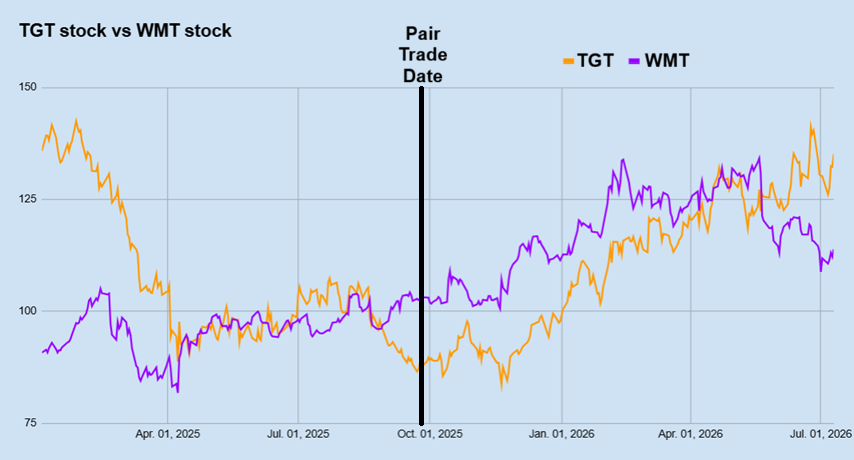
Successful investing requires knowledge, investigation, skilled analysis, and intuition, but also a certain amount of good fortune, especially regarding the timing of a trade. I was relatively fortunate to book the pair trade (for IEC reporting purposes) when Target’s stock was trading at a -$15 discount to that of Walmart. It wasn’t the absolute largest negative spread (that spread reached about -$23.50 in early-December 2025), but it was nonetheless a fortuitous time to present the trade.

At this point, about 9.5 months in, the pair trade is sitting on a profit of about +46.5%. NOTE – this return excludes the costs of borrowing WMT shares to Short. However, our checks suggest that borrowing costs for WMT have been quite low. Investors taking a less risky approach by purchasing put options of WMT will likely have earned a lower return, due to TVM (time value) cost.
Despite the continuing market disinterest in value stocks, investors have recently bid up shares of TGT to a point where they now again trade at a higher price than WMT. The sheer despair surrounding Target’s business and prospects seems to have dissipated to a large extent. No new goblins have been unearthed, and the CEO transition has occurred without any evident incident. More importantly, Target management foresees sales growth for 2026, alleviating concerns of an enduring sales slump.
Meanwhile, while Walmart did top Q1 estimates, management was very cautious in their guidance. Tariff and inflation pressures, especially energy inflation, were cited in the company’s earnings commentary. Guidance was issued below consensus. In my view, there was nothing terrible or surprising about Walmart’s results and outlook, but for a stock that was priced for perfection, at nearly 40x P/E, it presented an easy opportunity for investors to cash in on gains, which they have most certainly done. WMT stock hit a high of about $135 in mid-May, but has now meaningfully pulled back.
Concluding Comments
Official IEC performance calculations are reported on a 1-year basis. The average 1-year performance of all 530 bullish stock ideas featured on the IEC has been an outstanding +50.06%. (MUST SEE: Performance page). We haven’t decided whether to include pair trades within our standard reporting, but if we do, we’ll have to wait to see where the TGT/WMT pair settles on September 25, 2026, a few months from now, before grouping the thesis in with our standard results deck.
Philosophically, I would like to leave investors with the following statement copied from the original September 2025 recommendation of this TGT/WMT pair trade.
“Shareholder value is often unleashed from poorer companies becoming average companies, or average companies becoming great companies. Once a company is already great, operating like a hocheffizient German factory, there are no longer any low-hanging fruit. In fact, when I’m wearing my investor hat, I often see black marks like bad management teams favourably, like an opportunity for an improved situation, not a reason to look elsewhere.”
The above statement very much reflected how I felt about the Target/Walmart pair last Autumn, and it proved to be a very successful stance to take.

** RISK WARNING: Shorting stocks is inherently very risky, as the position is exposed to unlimited upside losses. Put options are a way to gain downside exposure without unlimited risk. You should always consult with a professional financial advisor before taking any investment actions.
About the author:
Jeffrey Fischer is a CFA Charterholder and the founder of The Investment Editor’s Cut. He was previously an investment analyst principally at Seeking Alpha. He is a CFA Charterholder with a 25+ year career in capital markets.
Disclaimer:
Content featured on The Investment Editor’s Cut website or newsletter constitutes investment research and analysis, but does not constitute investment advice. Readers should consult with a professional financial advisor before taking any investment actions.
Leave a Reply