
I’ve been monitoring the elevator industry this year, which approaches an oligopoly, with a few major firms holding a huge amount of the global business. Hoist devices date back to the B.C. period, while Elisha Otis is largely credited with inventing the modern elevator in the mid-nineteenth century. Not unlike Alexander Graham Bell, whose name continues to feature prominently in the corporate telecom space (ie: Bell Canada Enterprises), Otis’ name remains front and center in the elevator world with Otis Worldwide Corporation (OTIS) continuing as one of the industry’s leaders. His invention of the elevator safety break actually pre-dates the invention of the telephone by a few decades.
I’m not here to recommend OTIS, however. As is the case with many industries these days, tradeable United States-based corporations seem to be automatically favoured by investors as compared to their international counterparts. Now, while that might be sufficiently warranted for firms on the cutting edge of new technology, I don’t see really see that same merit within elevator manufacturing and servicing. The elevator industry has been in a bit of a slump lately, and I do see an opportunity in a more affordable, international, name.
The Big Players & Their Recent Performance
There are 3 dominant elevator firms worldwide, with two based in Europe, and then Otis headquartered in Connecticut. Schindler Holding AG is based in Switzerland, while KONE Oyj is headquartered in Finland. Germany’s TK Elevator used to make this a big-4 group, but recently entered an agreement to be acquired by KONE Oyj. Interestingly, prior to that deal, the annual revenues produced by these 4 major players were relatively level. Going forward, KONE Oyj will be the big fish, at least in terms of market share. The recent stock performance of these companies has been extremely correlated, and certainly not positive.
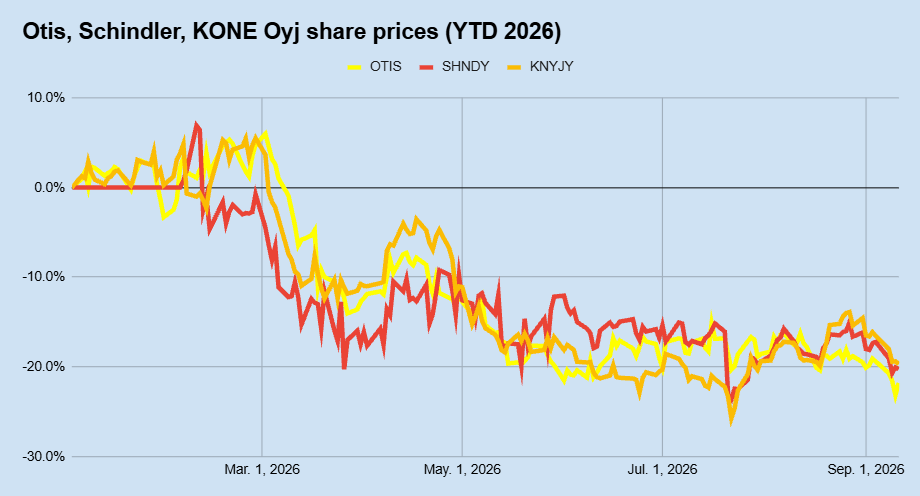
My understanding is that all the major elevator firms have faced a confluence of headwinds including i) higher input prices, ii) weakness in China, and iii) uneven real estate activity. Increasing interest rates (yields) globally certainly have not helped. Otis recently reduced its full-year outlook in July. Some members of the group have also noted competitive pressures, although I haven’t seen any meaningful deterioration in profit margins.
I don’t think there’s any real long-term reason to be fearful of investing in this industry. Besides a pick-up in new construction at some point, we must not forget that elevators generally need replacement or substantial modernization every 25 years or so. Then there’s the services business which earns these companies regular maintenance revenue. For Otis, its services segment drives about two-thirds of revenue. Service and modernization represented about 55% of revenue for KONE Oyk, at least prior to the TK integration. For Schindler, which operates in Switzerland and leaves much to be desired with its reporting, I wasn’t able to find a specific revenue breakdown. I don’t believe the split would stray far from its peers.
Steady, dependable, yet somewhat out-of-favour industrials are a favorite hunting ground of mine lately, and I see value here in elevators, especially for long-term investors. German research outfit Roland Berger updated their 2030 outlook for the elevator industry a few months ago. Recognizing some of the weakness in the Asia-Pacific region (which includes China), the firm lowered their 2030 global revenue forecast for the industry from USD 136 billion to USD 133 billion. While that admission of industry weakness is certainly worth noting, in my view it’s barely significant.
Starter Position in Schindler AG
Given the relative parity, ~common global exposure, relative lack of differentiation, and correlation between the 3 pure-play elevator company stocks, picking one of the three might amount to splitting hairs. I wouldn’t be surprised if Otis, Schindler AG, and KONE Oyj all see their stocks recover at approximately the same time. Nonetheless, I’m choosing to gain my exposure to a potential recovery in the industry through Schindler AG (SCHN.SW) (SHNDY).
I had actually briefly taken a position in Otis (OTIS), but I’m definitely an investor who’s partial towards unlevered firms, and Otis carries about $7 billion of debt against a market cap of some $26 billion. After researching the major industry players a bit more, I’ve swapped that position into Schindler AG, which has a market cap of $32.5 billion but also a net cash position of approximately $4.5 billion. KONE Oyj had net cash, but will be dispensing it in the TK Elevator deal, while also issuing a chunk of new shares. KONE Oyj’s shareholder dilution, and dependence on the successful integration are deterrents I choose to skip.
Schindler, meanwhile, has been making meaningful share buybacks this year with the stock notably discounted as compared to last year. SCHN.SW screens at a P/E of about 25x, but on an EV/FCF basis I see a multiple of less than 20x. The EV/sales ratio here is just above 2x, which is the lowest of the group. It’s also worth mentioning that Schindler’s recent results have been negatively impacted by a strong Swiss Franc, which has now come off in the past few months. Aluminum prices have also pulled back meaningfully, although steel and copper prices remain elevated.
Some input cost relief for the sector may be possible if the FOMC does raise interest rates this week and continues to strike a hawkish tone going forward. Regarding Schindler AG specifically, higher interest rates may yield benefits due to the net cash position.
Concluding Remarks
Growth has temporarily stalled for the elevator industry, and it has resulted in investment capital moving elsewhere. These sort of short-term reflexes often create opportunities that I sometimes refer to as time arbitrage, as also applied to my thesis on Vail Resorts.
The elevator industry is steady, defensible, and should continue growing in the medium/long-term, and today investors can pick up exposure to the sector at a discounted price. I’m expressing my view via a medium-sized position of Schindler AG, which also currently yields a dividend of ~2.5% (payout ratio below 50%).

About the author:
Jeffrey Fischer, CFA, is the founder of The Investment Editor’s Cut. He was previously an investment analyst principally at Seeking Alpha. He is a CFA Charterholder with a 25+ year career in capital markets.
Disclaimer:
Content featured on The Investment Editor’s Cut website or newsletter constitutes investment research and analysis, but does not constitute investment advice. Readers should consult with a professional financial advisor before taking any investment actions.
Leave a Reply